How to Do the Bicycle Crunch
The bicycle crunch alternates elbow-to-opposite-knee while your legs pedal, working your abs and obliques with a rotating motion. It is a bodyweight staple for beginners and works well in core circuits.
 Log every set of your Bicycle Crunch in Superlift
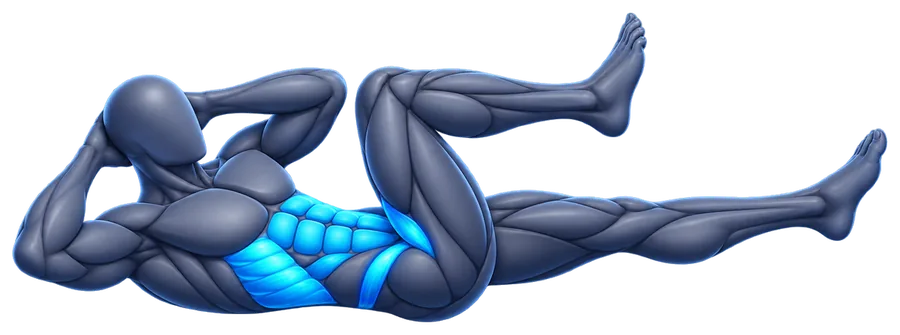
Muscles worked
Primary
- Abs
- Obliques
Secondary
- None to speak of
How to do the Bicycle Crunch
- 1
Lie on your back with your hands lightly behind your head.
- 2
Lift your shoulders off the floor and bring your knees up to 90 degrees.
- 3
Rotate your torso and bring one elbow toward the opposite knee.
- 4
Extend the other leg straight out, hovering above the floor.
- 5
Switch sides in a smooth pedaling motion.
- 6
Keep your lower back pressed toward the floor.
- 7
Count one rep per side.
Form cues to remember
- Turn your ribs, not just elbows
- Keep your lower back down
- Slow, smooth pedaling
- Don't pull on your neck
Common mistakes
Pulling on your neck
Rest fingertips behind your head and lead the movement with your torso.
Moving too fast
Slow down and pause on each side to feel the twist.
Elbows swinging without rotation
Turn your whole ribcage toward the knee.
Lower back arching
Extend your legs only as far as you can keep your back down.
Sets and reps
| Endurance | 3 sets of 20–40 reps per set, 30–45 seconds rest |
|---|---|
| Muscle growth | 3 sets of 12–20 slow reps with a pause each side |
| Conditioning | Use in a circuit: 30–45 seconds on, 15 seconds off |
Pulling on your neck can strain it, and an arched lower back signals your legs are extended too far. Keep your movements controlled.
Superlift for iPhone
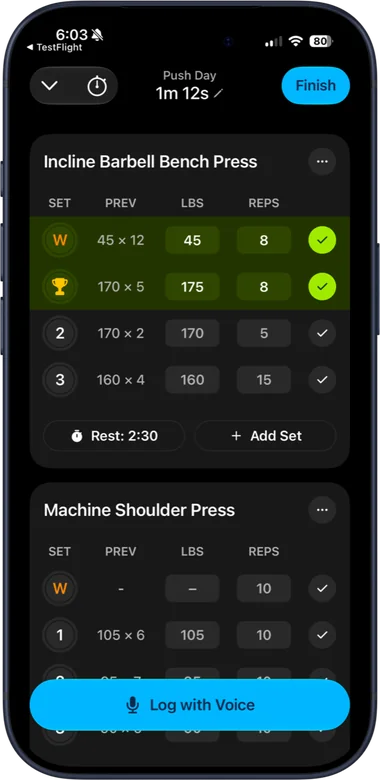
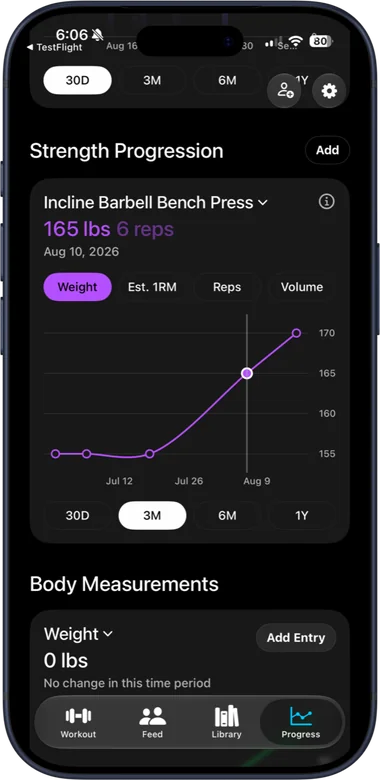
Track your Bicycle Crunch and watch it go up
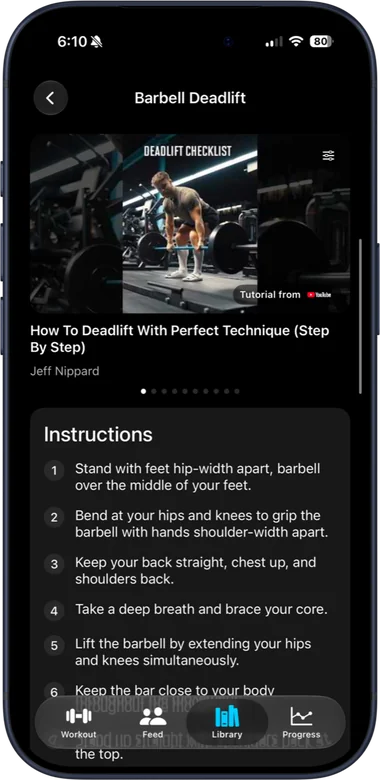
Superlift shows what you lifted last time, times your rest, and charts your strength week by week, so you always know what to beat. Every exercise in this library is built in, with the same demos and tutorials.
Bicycle Crunch FAQ
What muscles do bicycle crunches work?
They work your abs and obliques together, with your hip flexors helping the leg movement. The rotation is what shifts the focus to your obliques.
How many bicycle crunches should I do?
Try 3 sets of 20–40 total reps, counting each side. Go slower rather than adding more if the exercise feels too easy.
Bicycle crunch vs Russian twist?
The bicycle crunch is done lying down with your legs moving; the Russian twist is seated and rotates your torso. Both train your obliques in different positions.