How to Do the Clamshell
The clamshell is a floor exercise where you lie on your side and open your top knee like a clamshell, working the glute medius and deep hip rotators. It is a small, low-load move often used for hip stability, warm-ups and rehab-style work. It suits beginners, runners and anyone whose knees collapse inward on squats.
 Log every set of your Clamshell in Superlift
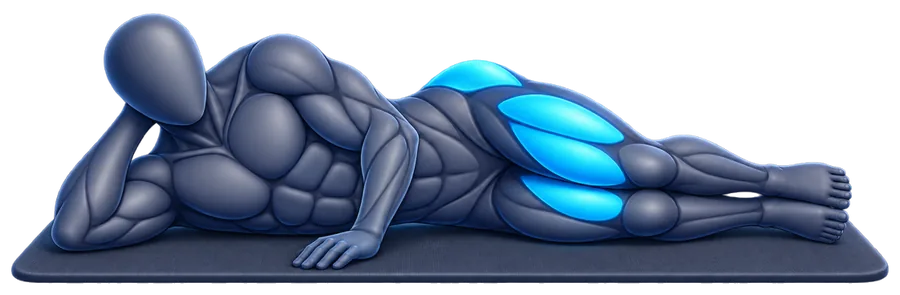
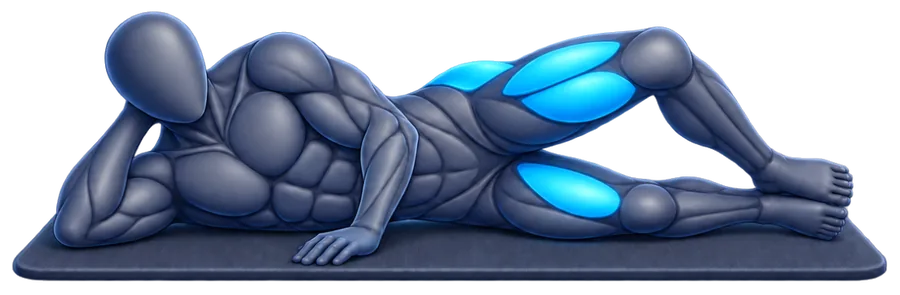
Muscles worked
Primary
- Abductors
Secondary
- Glutes
How to do the Clamshell
- 1
Lie on your side with your hips and knees bent about 45 degrees and your feet together.
- 2
Rest your head on your arm and stack your hips directly over each other.
- 3
Brace your abs lightly so your pelvis stays still.
- 4
Keep your feet touching and lift your top knee as high as you can without rolling back.
- 5
Pause for a second at the top.
- 6
Lower your knee slowly, then finish all reps before switching sides.
Form cues to remember
- Hips stay stacked
- Feet stay together
- Lift with your glutes, not your back
- Pause at the top
Clamshell video tutorial
Common mistakes
Rolling your pelvis back
Keep your hips stacked and stop when your pelvis starts to move.
Rushing the reps
Lift and lower slowly with a short pause.
Using your lower back
Brace your abs and move only your top knee.
Lifting your feet apart
Keep your feet touching so the hip, not the ankle, does the rotation.
Sets and reps
| Muscle growth | 2–3 sets of 15–20 reps per side, 30–45 sec rest |
|---|---|
| Endurance | 2 sets of 20–30 reps per side with a mini band |
Keep the movement small and controlled, and stop if you feel pinching in your hip. Add a resistance band only when you can keep your pelvis still.
Superlift for iPhone
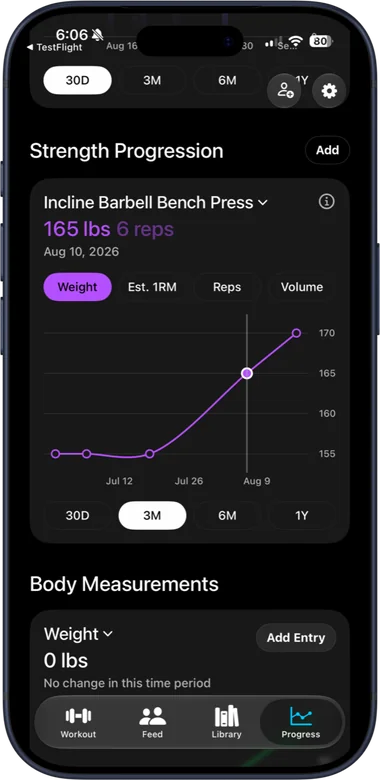
Track your Clamshell and watch it go up
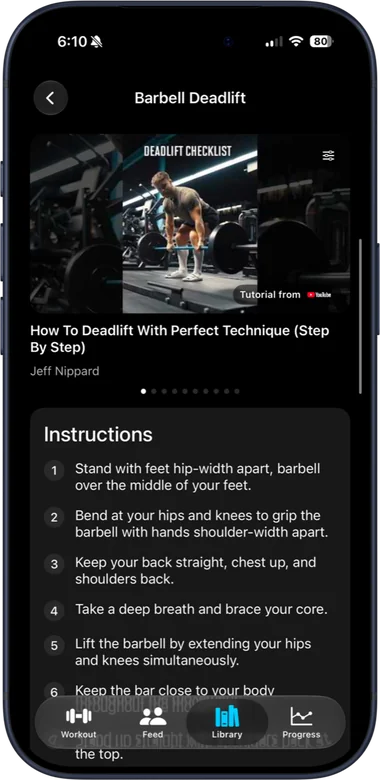
Superlift shows what you lifted last time, times your rest, and charts your strength week by week, so you always know what to beat. Every exercise in this library is built in, with the same demos and tutorials.
Clamshell FAQ
What muscles do clamshells work?
They work the glute medius and the deep hip rotators. These muscles help keep your pelvis and knees stable.
Why can't I feel clamshells in my glutes?
Your pelvis may be rolling back or you're moving too fast. Stack your hips and slow down so the side of your hip does the work.
Are clamshells worth doing?
They're useful for glute activation and hip stability, especially as a warm-up. For serious strength, pair them with squats, lunges and hip thrusts.