How to Do the Ski Erg
The Ski Erg is a machine where you pull two handles from overhead down to your hips, mimicking a cross-country ski pole motion. It trains your lats, abs and hips together, and is a strong cardio option that is easy on your legs. It suits intermediate gym-goers looking for upper-body-focused conditioning.
 Log every set of your Ski Erg in Superlift
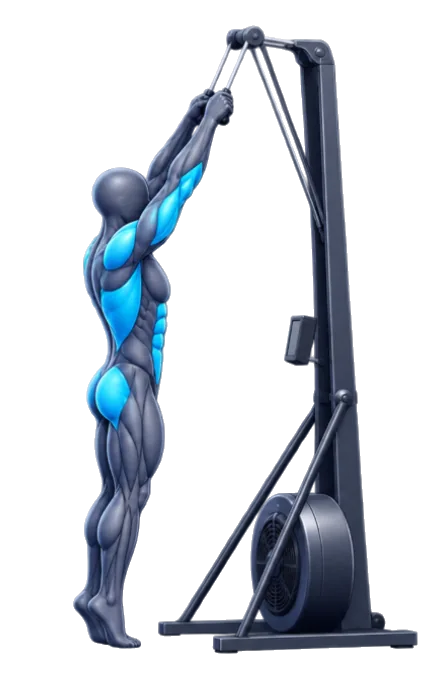
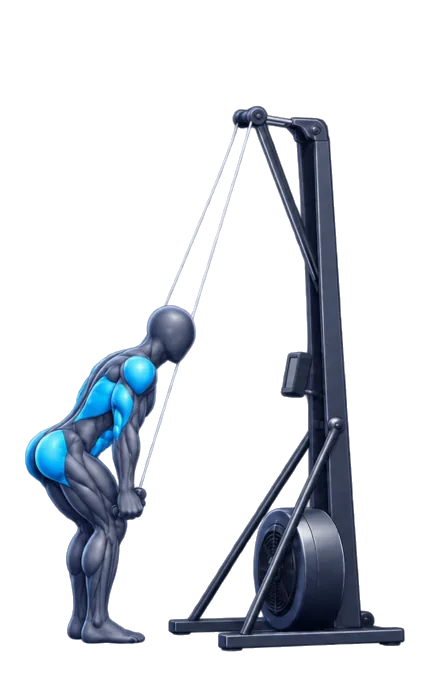
Muscles worked
Primary
- Lats
- Abs
Secondary
- Shoulders
- Triceps
How to do the Ski Erg
- 1
Stand facing the machine with your feet shoulder-width apart and grab both handles.
- 2
Reach tall with your arms overhead and your chest up.
- 3
Start the pull by engaging your lats and bending slightly at the knees.
- 4
Pull the handles down toward your hips while hinging forward.
- 5
Finish with your arms past your hips and your core braced.
- 6
Let the handles rise as you stand back up.
- 7
Repeat in a steady rhythm for your time or distance.
Form cues to remember
- Reach tall, pull long
- Hinge, don't just bend
- Brace your abs
- Smooth, steady rhythm
Ski Erg video tutorial
Common mistakes
Pulling with just your arms
Use your lats, abs and hips; hinge as you pull.
Bending your back
Keep your chest long and hinge from your hips.
Rushing each stroke
Slow the return so you can set up the next pull.
Standing stiff
Bend your knees slightly to add leg drive.
Sets and reps
| Conditioning | 6–10 rounds of 30–60 seconds hard, with equal rest |
|---|---|
| Endurance | 10–20 minutes at a steady, moderate effort |
| Strength | 5–8 rounds of 10–15 strong, powerful pulls |
Hinging with a neutral spine protects your lower back, so stop if you feel it round. Start at a low damper setting to learn the motion.
Superlift for iPhone
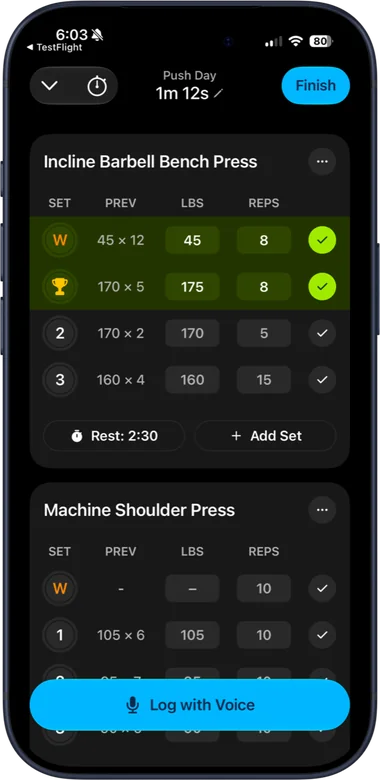
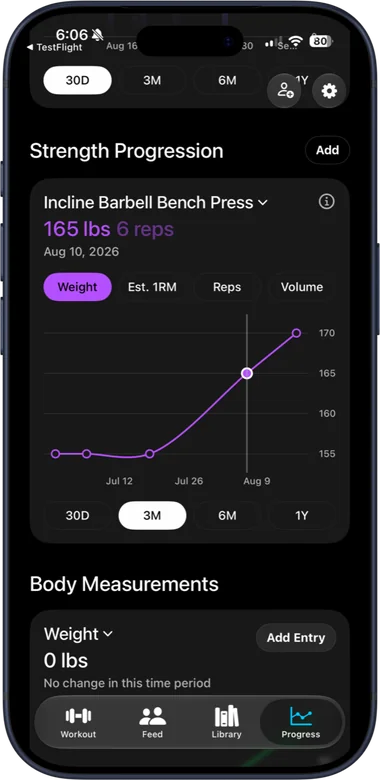
Track your Ski Erg and watch it go up
Superlift shows what you lifted last time, times your rest, and charts your strength week by week, so you always know what to beat. Every exercise in this library is built in, with the same demos and tutorials.
Ski Erg FAQ
What muscles does the Ski Erg work?
Mostly your lats, abs and triceps, with your shoulders and hips helping drive each pull.
Is the Ski Erg harder than a rower?
Many people find it more demanding on the upper body and core, though a rower uses your legs more. Both are strong cardio tools.
What damper setting should I use on the Ski Erg?
A lower damper, such as 3–5, is often best for learning. A higher damper feels heavier but is not necessarily faster.