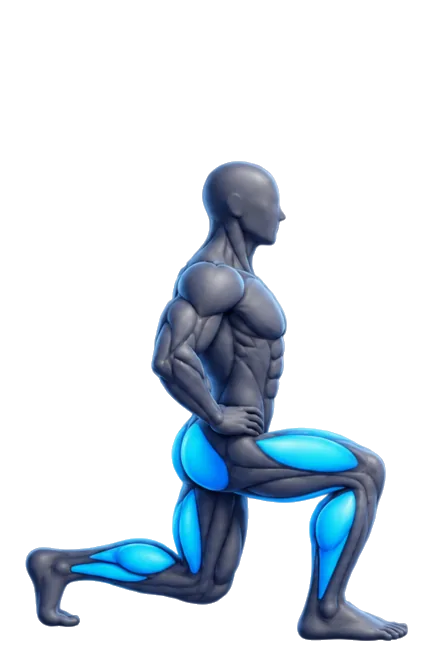
How to Do the Weighted Step-Up
The weighted step-up has you step onto a box while holding dumbbells, working one leg at a time. It builds quads and glutes, helps correct side-to-side imbalances, and is easier on your back than heavy squats.
 Log every set of your Weighted Step-Up in Superlift
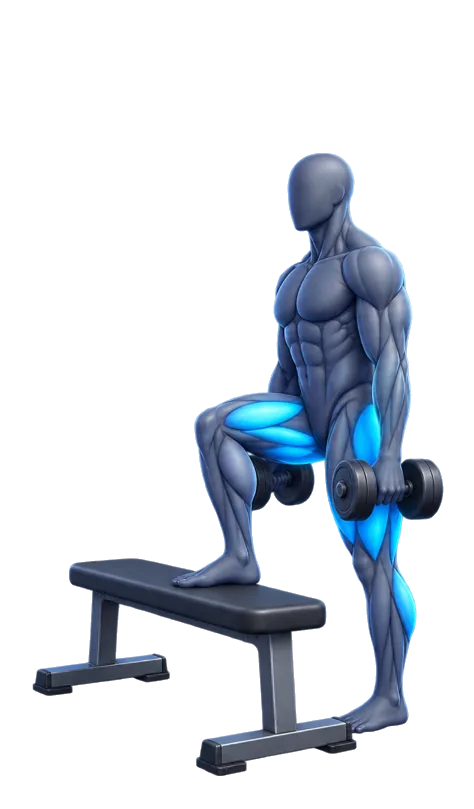
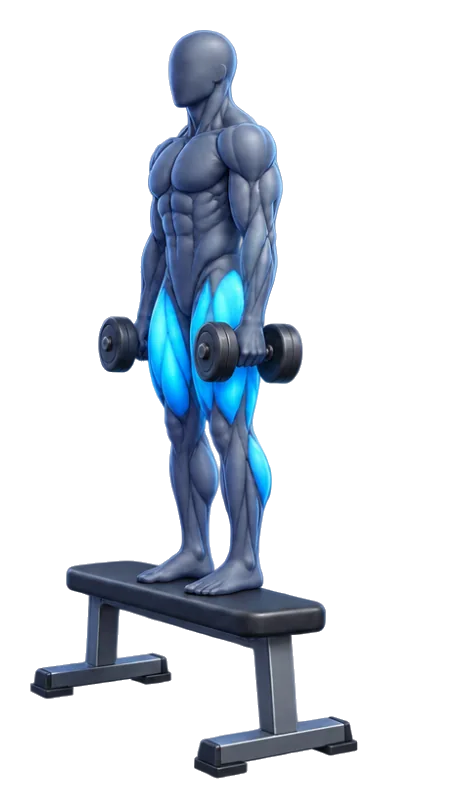
Muscles worked
Primary
- Quads
- Glutes
Secondary
- Hamstrings
How to do the Weighted Step-Up
- 1
Hold a dumbbell in each hand and stand facing a box or bench.
- 2
Place one foot fully on the box with your knee over your ankle.
- 3
Drive through the heel of your front foot and stand up on the box.
- 4
Bring your back foot up to stand tall.
- 5
Lower the back foot with control to the floor.
- 6
Finish all reps on one leg, then switch.
- 7
Keep your torso upright throughout.
Form cues to remember
- Drive through your front heel
- Stand tall at the top
- Lower slowly
- Keep your hips level
Weighted Step-Up video tutorial
Common mistakes
Pushing off the back foot
Let the working leg do the lifting; tap the back foot lightly.
Box too high
Use a height where your thigh is about parallel to the floor.
Leaning forward
Keep your chest up and torso tall.
Dropping down fast
Take 2–3 seconds to lower each rep.
Sets and reps
| Muscle growth | 3 sets of 8–12 reps per leg, 60–90 seconds rest |
|---|---|
| Strength | 3–4 sets of 5–8 reps per leg with heavier dumbbells |
| Endurance | 2–3 sets of 12–15 reps per leg with a light load |
Use a stable box and a height you can control to avoid slips. Start light if your balance or knees are an issue.
Superlift for iPhone
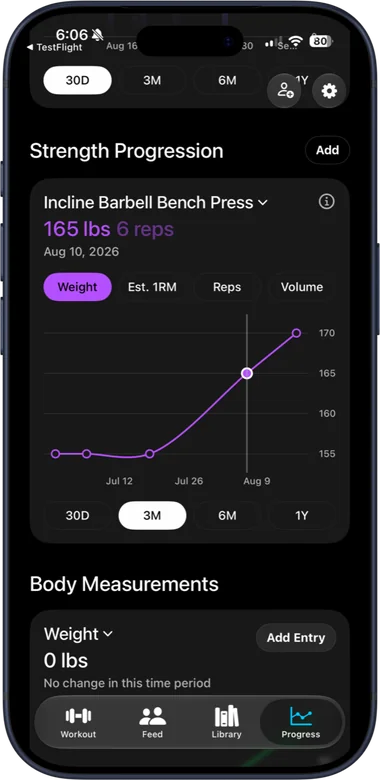
Track your Weighted Step-Up and watch it go up
Superlift shows what you lifted last time, times your rest, and charts your strength week by week, so you always know what to beat. Every exercise in this library is built in, with the same demos and tutorials.
Weighted Step-Up FAQ
What do step-ups work?
They work your quads and glutes, with your hamstrings assisting. Your core and hip stabilizers keep your hips level.
Does box height matter for weighted step-ups?
Yes. A higher box emphasizes your glutes more but is harder to control; a lower box is easier and works the quads more.
Weighted step-up vs lunge: which is better?
Step-ups keep your front foot planted on a box and need less balance. Lunges involve more balance and a longer stride.